Take time on the Sabbath to discuss the importance of emergency preparedness with family & neighbors. Establish a 3 month supply of water and food and rotate it. Actively participate in all emergency response drills. Maintain a "red file" for your most important documents. Live righteously, practice the welfare principle of self-reliance and build a three to six month financial reserve.

Tuesday, June 19, 2012

Honeyville Farms - Cookin' Cousins- Make your own Trail Mix


Honeyville Farms - Cookin' Cousins marketing@honeyvillefarms.net via google.com 
May 26
to me

Honeyville Farms - Cookin' Cousins


Posted: 25 May 2012 08:50 PM PDT
With Honeyville's Freeze Dried Fruits and Veggies it is super easy to make your own trail mix! What a healthy, easy snack! You could use it for an after school snack, camping (it is the camping season, right?), something to grab for the road, or even munch on during work. If you wanted you could even pre-bag several of these so they are ready to go anytime you need them.
I could think of several varieties, but today, I tried two and they were both delicious!


#1 attempt:
Honeyville Freeze Dried Bananas
Honeyville Freeze Dried Mangos
Honeyville Freeze Dried Pineapple
Honeyville Freeze Dried Strawberry Yogurt Bites
(I put peanuts in mine after the picture was taken. I liked it a lot with peanuts, my hubby voted against them)


#2 attempt:
Honeyville Freeze Dried Strawberries
Honeyville Freeze Dried Raspberries
Honeyville Freeze Dried Strawberry Yogurt Bites
Honeyville Freeze Dried Blackberries
Honeyville Freeze Dried Blueberries
M&M's (I couldn't resist leaving out the chocolate!)


Of course, there are so many different ways you could make your own trail mix. So get creative and have fun!!!


Enjoy!


Honeyville Farms - Cookin' Cousins-Meatballs and Marinara Recipe


Posted: 24 May 2012 01:15 PM PDT
We love it when Chef Tess shares her recipes and wisdom with us!  She's been making food storage magic using the Freeze Dried Ground Beef and Tomato Powder.  Take it away Chef Tess...
Hello my darlings! It's always a giant treat to come and play  work with the Cousins! Being the chef for Honeyville is such a fun job and I can't believe how many adventures I am having writing the cookbook and preparing new and delicious meals using their foods!
 Today I want to share a simple and easy dinner that is ready in 30 minutes or less using just food storage.  Freeze Dried Ground Beef is interesting stuff isn't it? The Benefits of Freeze Dried Meat are pretty amazing and the shelf life is 10-15 years if kept in a cool dry place. I cook with it a lot more than I ever thought I would just because it is so convenient and I love developing recipes that people can really use. I had a gal ask me what I do with the ground beef if I wanted to make meatballs or a meatloaf and I wanted to share my simple method for that.  I've also got some great tips on How to Use Tomato Powder to make an Instant Marinara sauce with excellent flavor and a 10-15 years shelf life! That's awesome right?! Usually a good marinara takes a long time to develop that flavor. It's especially amazing if you can a make it so delicious your family won't mind eating it any night of the week.

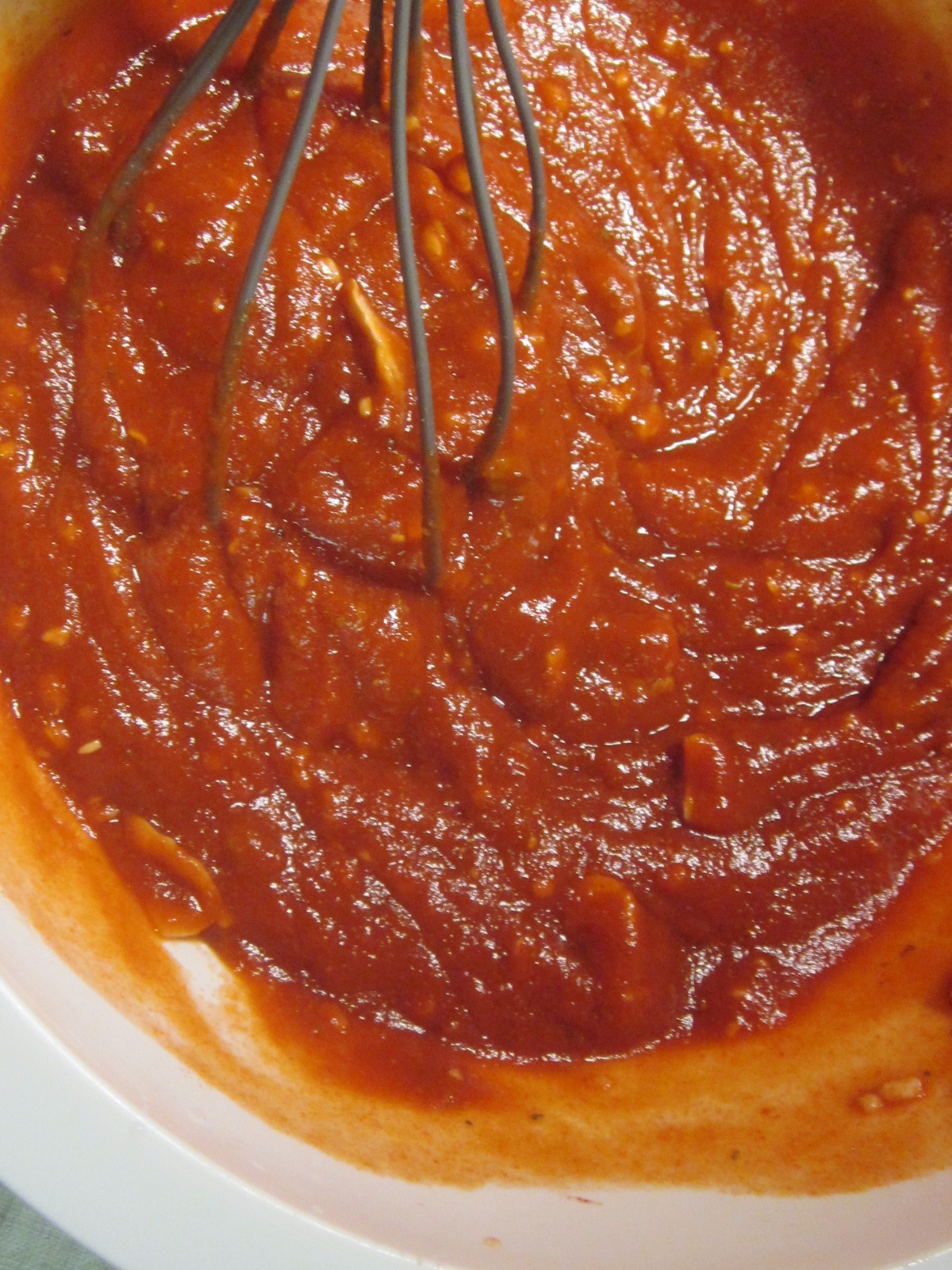
Chef Tess Bakeresse™ Instant Marinara
 and Meatballs from Food Storage
Ingredients:
Meatballs:
2 cup Honeyville Freeze Dried Ground Beef
1 cup whole wheat bread crumbs
1/4 cup Honeyville Freeze Dried Onions
1/2 cup Honeyville Whole Egg Powder
1 tsp Chef Tess Romantic Italian Seasoning
1 tsp garlic powder
Sauce:
1/2 cup Honeyville tomato powder
1/4 cup Honeyville freeze dried onions
1/4 cup Honeyville freeze dried bell peppers
1/4 cup Honeyville freeze dried mushrooms
2T Honeyville dehydrated honey
2tsp Chef Tess Romantic Italian Seasoning
1/4 cup Ultra Gel (modified corn starch) available in Honeyville retail stores

To make the meatballs, combine the meatball dry ingredients in a quart size bowl mixing well. Add 1 1 1/3 cup hot water (not boiling but very hot). Stir the water into the beef mixture and then allow the mixture to sit 10 minutes to fully hydrate and becomes a workable mass. Mmm. Meat moosh.
Form into 18 small meatballs and place on a lightly oiled baking sheet about a half an inch apart.
Now...bake them 15-20 minutes at 350 degrees until firm to the touch. I like to lightly tent aluminum foil over the sheet pan, as this helps the meatballs to steam and keeps them tender.  Remove from the oven and serve hot or cool and place in a fridge (covered) for later use.

To prepare the instant sauce:

Combine the dry ingredients in a half gallon size pot.
Add 3 1/2 -4 cups warm water (depending on how thick you want your sauce) and stir well. Stir over low heat. Cooking the sauce is optional, by the way.  If you are just wanting a fast pizza sauce or bread stick dipping medium this stuff will make you happy! I usually do the sauce heating while the meatballs bake. This is also the time I start the water boiling if I'm serving the sauce and meatballs with pasta. Usually I just hide somewhere with a steaming pot of liquid happiness and a spoon and hide. Try not to think about how weird I am. Weirdness is a gift that I will always claim...(said as I strap on my moon-boots and rick-rac embellished pocket protector).
Stir sauce until heated through and vegetables are tender. Add the meatballs to the sauce and serve over steaming hot pasta.
You know what else? This magical marinara sauce is great for long-term food storage, unlike canned sauces. Plus you control all the ingredients! Combine the dry ingredients in a half pint jar with a tightly fitting lid and an oxygen absorber and it is good 5-10 years if kept in a cool dry place. Now that is amazing!

There you go. Make some beautiful meatballs and marinara with your food storage. It's sure to impress your mother-in-law.

Always My Very Best,
Your Friend Chef Tess

FEMA Urges Preparedness for Hurricanes and Severe Weather


FEMA Urges Preparedness for Hurricanes and Severe Weather
Inbox
x

Ready Campaign ready@service.govdelivery.com
May 24
to me
Mobile wireless emergency alerting capabilities will be available nationwide through participating carriers

WASHINGTON - Hurricane Season begins June 1, 2012, FEMA is providing additional tools for federal, state, local, tribal and territorial officials to alert and warn the public about severe weather. Using the Commercial Mobile Alert System, or CMAS, which is a part of FEMA's Integrated Public Alert and Warning System, this structure will be used to deliver Wireless Emergency Alerts (WEA) to wireless carriers for distribution to the public.

The CMAS system will allow the National Weather Service to soon begin issuing WEAs for the most dangerous weather through participating wireless carriers directly to cell phones. The alerts will be broadcast by cell towers much like an AM/FM radio station, and cell phones within range will immediately pick up the signal, provided they are capable of receiving these alerts. The availability of WEA alerts will be dependent on the network status of the wireless carriers and handset availability, since not all cell phones can receive WEAs. People should check with their cellular carriers to see if WEA alerts are available in their area.

"The wireless emergency alert capability provides an additional opportunity for the public to receive life-saving information needed to get out of harm's way when a threat exists," said Timothy Manning, FEMA deputy administrator for protection and national preparedness. "The public also has a critical role in their personal preparedness. There are a few simple steps that everyone can take to be prepared, like knowing which risks exist in your area and making a family emergency plan. Information and resources to help individuals and families prepare can be found at ready.gov."

WEAs will look like a text message, and will automatically appear on the mobile device screen showing the type and time of alert along with any action that should be taken. The message will be no more than 90 characters, and will have a unique tone and vibration, indicating a WEA has been received. If an alert is received, citizens should follow the instructions and seek additional information from radio, television, NOAA Weather Radio, and other official sources for emergency information. Citizens should only call 911 in a life threatening situation.

Only authorized federal, state, local, tribal or territorial officials can send WEA alerts to the public. As with all new cellular services, it will take time for upgrades in infrastructure, coverage, and handset technology to allow WEA alerts to reach all cellular customers.

FEMA urges individuals and businesses to take action to prepare themselves in advance of severe weather and hurricanes such as taking the pledge to prepare at www.ready.gov/pledge. This is the first step in making sure you and your family is ready for an emergency. This includes filling out your family communications plan that you can email to yourself, assembling anemergency kit, keeping important papers and valuables in a safe place, and getting involved.

With the start of hurricanes season it is even more important to know your risk, take action, and be an example. While hurricanes often offer some warning that a threat is approaching, severe weather can occur at any time and in any place, including high winds, inland flooding, severe storms and tornadoes.

For more on family preparedness, visit www.ready.gov/hurricanes for more planning information and safety tips.

FEMA's mission is to support our citizens and first responders to ensure that as a nation we work together to build, sustain, and improve our capability to prepare for, protect against, respond to, recover from, and mitigate all hazards.

Fruit Pancakes Recipe


Posted: 16 May 2012 01:22 PM PDT
Blueberries are typically the fruit of choice when adding fruit to pancake batter.  However, today I had some Freeze Dried Apricots on hand so I tried them out.  Super delicious!  Honeyville's Buttermilk Pancake mix is so versatile-it is great as is or one can add in things and it performs awesome too!


Apricot Pancakes
Ingredients:
1 cup Water
3/4 cup Honeyville Freeze Dried Apricots
1 cup Honeyville Buttermilk Pancake & Waffle Mix

Directions:
In a bowl combine water and apricots.  Let sit 1 minute to allow apricots to rehydrate.  Do NOT drain the water.  Add the pancake mix and stir until fairly smooth.  The batter will have some lumps from the apricots and mix.  Pour 1/4 cup of batter onto a greased, preheated griddle (about 375 degrees).  Cook pancakes until bubbles appear on the top and the edges have a dry appearance; about one minute, turn just once and cook for one more minute.

I topped my stack of pancakes with more apricots that I had hydrated while the pancakes cooked and a drizzle of maple syrup and some whipped cream.  Not everyday do I put whipped cream on my pancakes but we had some leftover from Mother's Day and I can't waste it right?!  I think some yogurt on top or some flavored honey would be dynamite as well.

Week # 24: 6 Quarts of Oil & 4 quarts Olive Oil


Week # 24: 6 Quarts of Oil & 4 quarts Olive Oil 

(Store the kind of oil you use!!! I love coconut Oil. It is very healthy for you.  Go to www.tropicaltraditions.com   I love the Expeller Pressed coconut oil because it is tasteless and odorless.  Great when cooking things that you don't want to taste like coconut. It never goes rancid either.)

(If you can’t accomplish this in 1 week, don’t worry, just take your time and do it in steps.)
Oil:oilsinjars_190
There are so many oils on the market to choose from. Simply store the kind of oils which you use and rotate them because Oil doesn’t last very long (max 1-2 years check the expiration date). The following information is here to guide you and if you already know what kind of oil you need then don’t even worry about reading the rest, however if you’re not sure what kind you want/need or would like to switch then read on.

Types of Oil:
Natural fats contain varying ratios of three types of fats: saturated, monounsaturated and polyunsaturated.
Saturated fats are hard at room temperature. They’re stable, resist oxidation, and are found primarily in meat and dairy but also in palm and coconut oil.
Polyunsaturated fats are liquid at room temperature and the least stable. They oxidize easily and are found in seafood and corn, safflower, soybean and sunflower oils.
Monounsaturated fats are more stable generally than polyunsaturates. They’re found in canola, nut and olive oils.
The American Heart Association (AHA) recommends limiting saturated fats in the diet due to their association with cardiovascular disease. The AHA also recommends relying more on monounsaturates than polyunsaturated fats.
PRESSED VS. CHEMICALLY EXTRACTED
The oils at PCC may be less familiar than brands in mass-market grocery stores — for good reason. PCC buyers seek out natural oils that are mechanically pressed from the seed without using chemical solvents.
Olive, avocado and walnut oils, for example, are from soft fruit or nuts that need only expeller pressing and centrifuging; they may be labeled “cold-pressed.”
Hard oilseeds such as soy or canola usually require some pre-treatment such as steam before pressing but still do not rely on chemical solvents.
In contrast, mass-market oils generally are extracted with toxic solvents such as hexane. These oils then undergo harsh treatment to remove the solvent. More chemicals, very high heat, and straining are used to deodorize and bleach the oils — rendering them inferior in taste, fragrance, appearance and especially nutritional quality.
UNREFINED OILS
Unrefined oils are filtered only lightly to remove large particles. Some, such as sesame or olive oil, may appear cloudy or have visible sediment after sitting. This does not compromise quality.
Unrefined oils are “whole” oils and their flavor, color and fragrance are more pronounced than in refined oils. Like unrefined whole grain flours, unrefined oils are more nutritious and have a shorter storage life than refined.
Unrefined oils are best used unheated in dressings or in low heat, sautéing or baking. Their natural resins and other beneficial particles burn easily and develop unpleasant flavors and unhealthful properties if overheated. If you choose to bake with unrefined oils, expect the flavor to be more pronounced.
REFINED OILS
Naturally refined oils are more thoroughly filtered and strained than unrefined, usually with some additional heat, but without harsh or damaging chemicals. Refining reduces the nutrient level and flavor. It also removes particles and resins and makes naturally refined oils more stable for longer storage, more resistant to smoking, and a good choice for high-heat cooking and frying.
Refined oils recommended for high heat cooking and deep-frying are “high oleic” forms of safflower and sunflower oil. These are from plants bred to be high in onounsaturated fats instead of polyunsaturates, which oxidize easily and aren’t suited for high heat. To check if it’s “high oleic,” read the nutrition panel on the bottle. It lists polyunsaturated and monounsaturated fats separately.
The info above was found on: PCC Natural Markets (They also have a great chart to help you choose.)
picture-1
picture-2
Click here to read about Olive Oil.
Click here to read and learn more about Vegetable Oils
Click here to read about Vegetable Oil and Weight Gain.
Click here to read about Olive Oil vs. Canola Oil
Click here to read Cooking Oil Data
442px-olive_oil_from_onegliaStoring Oil:
All oils, especially unrefined oils, should be refrigerated after opening to prevent oxidation and rancidity. Natural oils should smell and taste fresh and pleasant. Can’t tell? If in doubt, throw it out. Studies indicate that rancid fats may promote cancer and heart disease.
Oil that’s firmed up in the refrigerator will liquefy at room temperature in a few minutes. Place the bottle in a container of warm — not hot — water for five minutes. The quality will not be harmed.
So you have to make sure you rotate your oils, and not store them longer than a year, the expiration date. In a nut shell, don’t sit on your oil supply for years without rotating it. Just a little bit rancid is just a little bit poisonous.
Because of this difficulty in storing fats and oils for any long period of time many books and articles on the subject of food storage make only passing mention of them, if they say anything at all. This is unfortunate because fat contains nine calories per gram compared to the four calories contained by either carbohydrates or protein. This makes fat a valuable source of concentrated calories that could be of real importance if faced with a diet consisting largely of unrefined grains and legumes. For small children, infants and the elderly, they may not be able to consume the volume of food that would be necessary in the course of a day to get all of the calories they would need to avoid weight loss and possible malnutrition. Additionally, fats play an important role in our perception of taste and texture and their absence would make many foods more difficult to prepare and consume. Furthermore, a small amount of dietary fat is necessary for our bodies to properly absorb fat soluble vitamins like A,D,E and K.
Long term storage of fats may be problematical, but it is not impossible. There are some general rules you can follow to get the most life out of your stored cooking oils and fats.
  1. Exposure to oxygen, light and heat are the greatest factors to rancidity. If you can, refrigerate your stored oil, particularly after it’s been opened. If possible, buy your oils in opaque, airtight containers. If you purchase it in plastic, particularly clear plastic, then transfer it to a gas impermeable glass or metal container that can be sealed airtight. If you have a means of doing so, vacuum sealing the storage container is an excellent idea as it removes most of the air remaining inside, taking much of the oxygen with it. Transparent glass and plastic containers should be stored in the dark, such as in a box. Regardless of the storage container, it should be stored at as cool a temperature as possible and rotated as fast as is practical. Oils and fats with preservatives added by the manufacturer will have a greater shelf life than those without them, provided they are fresh when purchased.
  2. Unless they have been specially treated, *unopened* cooking oils have a shelf life of about a year, depending upon the above conditions. Some specialty oils such as sesame and flax seed have even shorter usable lives. If you don’t use a great deal of it, try not to buy your fats in large containers. This way you won’t be exposing a large quantity to the air after the you’ve opened it, to grow old and possibly rancid, before you can use it all up. Once opened, it is an excellent idea to refrigerate cooking fats. If it turns cloudy or solid, the fat is still perfectly usable and will return to its normal liquid, clear state after it has warmed to room temperature. Left at room temperatures, opened bottles of cooking oils can begin to rancid in anywhere from a week to a couple of months, though it may take several more months to reach such a point of rancidity that it can be smelled.
  3. Although darker colored oils have more flavor than paler colored, the agents that contribute to that flavor and color also contribute to faster rancidity. For maximum shelf life buy paler colored oils.
- - - - - - - - - - - - - - - - - - - - - - - - - - - - - - - - - - - - - - - -
Click on the images below to view all 52 weeks at once or the recipes to go with it, in a .jpg or download the 52 Week Food Purchasing Plan (PDF) or the Custom 52 Week Food Purchasing Plan (Excel file) and calculate exactly how much you’ll need for the size of your family.
weeklypurchasingplan-new using-your-52-weeks

Week # 23: 10 lbs or 20 Cups of Jams or Fruit Preserves


jam3Week # 23: 10 lbs or 20 Cups of Jams or Fruit Preserves
(If you can’t accomplish this in 1 week, which you probably will not because this is an ongoing process, don’t worry, just take your time and do it in steps.)
Fruit Preserves
Fruit preserves refers to fruits or vegetables that have been prepared and canned for long term storage. The preparation of fruit preserves traditionally involves the use of pectin as a gelling agent, although sugar or honey may be used as well. There are various types of fruit preserves made globally, and they can be made from sweet or savory ingredients.
Preserves
The term Preserves is usually interchangeable with Jam. Some cookbooks define Preserves as cooked and gelled whole fruit (or vegetable), which includes a significant portion of the fruit.
Jam
Jam contains both fruit juice and pieces of the fruit’s (or vegetable’s) flesh,[12] however some cookbooks define Jam as cooked and gelled fruit (or vegetable) purees.[13]
Properly, the term jam refers to a product made with whole fruit, cut into pieces or crushed. The fruit is heated with water and sugar to activate the pectin in the fruit. The mixture is then put into containers. The following extract from a US cookbook describes the process.
“Jams are usually made from pulp and juice of one fruit, rather than a combination of several fruits. Berries and other small fruits are most frequently used, though larger fruits such as apricots, peaches, or plums cut into small pieces or crushed are also used for jams. Good jam has a soft even consistency without distinct pieces of fruit, a bright color, a good fruit flavor and a semi-jellied texture that is easy to spread but has no free liquid.” - Berolzheimer R (ed) et al. (1959)
Uncooked or minimally cooked (less than 5 minutes) jams, are called freezer jam, because they are stored frozen.
Jellyjam2
The term jelly refers to a type of clear fruit spread consisting of firmed fruit (or vegetable) juice made with pectin. Jelly can be made from sweet, savory or hot ingredients. Jelly is made by a similar process to jam, with the additional step of filtering out the fruit pulp after the initial heating. A cloth “jelly bag” is traditionally used as a filter.
“Good jelly is clear and sparkling and has a fresh flavor of the fruit from which it is made. It is tender enough to quiver when moved, but holds angles when cut.
EXTRACTING JUICE - Pectin is best extracted from the fruit by heat, therefore cook the fruit until soft before straining to obtain the juice … Pour cooked fruit into a jelly bag which has been wrung out of cold water. Hang up and let drain. When dripping has ceased the bag may be squeezed to remove remaining juice, but this may cause cloudy jelly.” - Berolzheimer R (ed) et al. (1959)
Marmaladejam1
American-style marmalade is sweet, not bitter. In English-speaking usage “marmalade” almost always refers to a preserve derived from a citrus fruit, most commonly oranges. The recipe includes sliced or chopped fruit peel, which is simmered in fruit juice and water until soft; indeed marmalade is sometimes described as jam with fruit peel (although many companies now also manufacture peel-free marmalade). Such marmalade is most often consumed on toasted bread for breakfast.
Jam & Recipes for Home Storage
Because we feel that Ball, the most popular preserving company, has a lot of great info on their site we’ll direct you to their site to review recipes and how to preserve your fresh or frozen fruits.
Here are a few free Printable PDF Recipe sheets from PickYourOwn.org.
THE Book! 
You’ll for sure need the “Blue Book of Preserving” from Ball if your thinking about canning/jarring your fresh food. It tells you in simple instructions how to can almost anything; complete with recipes for jelly, jellies, pickles, sauces, canning vegetables, meats, etc. If it can be canned, this book likely tells you how!Personally we wouldn’t pay more than $9 for this book, but not because it’s not worth more, but because that’s just a good deal. You can even find it for $5.48.
ballbluebook
- - - - - - - - - - - - - - - - - - - - - - - - - - - - - - - - - - - - - - - -
Click on the images below to view all 52 weeks at once or the recipes to go with it, in a .jpg or download the 52 Week Food Purchasing Plan (PDF) or the Custom 52 Week Food Purchasing Plan (Excel file) and calculate exactly how much you’ll need for the size of your family.
weeklypurchasingplan-new using-your-52-weeks

Week # 22: 2 (5 lb) tubs of Honey & 6 lbs Corn Syrup

Week # 22: 2 (5 lb) tubs of Honey & 6 lbs Corn Syrup (Personally I do not store corn syrup due to research on it's adverse effect to one's health) Agave works well in most cases as a substitute. Check it out here.

(If you can’t accomplish this in 1 week, don’t worry, just take your time and do it in steps.)
Honey

This wonderfully rich golden liquid is the miraculous product of honey bees and a naturally delicious alternative to white sugar. In addition to its reputation as Nature’s nutritive sweetener, research also indicates that honey’s unique composition makes it useful as an antimicrobial agent and antioxidant.
Selection:
Raw honey that has not been pasteurized, clarified, or filtered - provided it is of the highest organic quality - is your best choice. Look for honey that states “100% pure.” While regular honey is translucent, creamy honey is usually opaque and is made by adding finely crystallized honey back into liquid honey. Specialty honeys, made from the nectar of different flowers, such as thyme and lavender, are also available. Remember that the darker the color, the deeper the flavor.
Warning:
Remember that the quality of “raw” honey is a function of the plants and environment from which pollen, saps, nectars and resins were gathered. Other substances found in the environment - including traces of heavy metals, pesticides, and antibiotics - have been shown to appear in honey. The amount varies greatly.
Do not feed honey-containing products or use honey as a flavoring for infants under one year of age. Honey is safe for children older than 12 months and adults.
By The Way: Rice’s Lucky Clover Honey (The Bear which we buy at Walmart) is packing only 100% pure raw unfiltered honey. 
Benefits: 
  • Kosher approved
  • Helps control allergies
  • Good for replacing sugar
  • A good sweetener that can be used in coffee, tea, and smoothies
  • Honey is composed primarily of carbohydrates and water, and also contains small amounts of a wide array of vitamins and minerals
  • Carbohydrate ingestion prior to, during, and after exercise enhances athletic performance and speeds recovery
Storage:
It is important to keep honey stored in an airtight container so that it doesn’t absorb moisture from the air. Honey stored this way in a cool dry place will keep almost indefinitely. One reason for this is that its high sugar content and acidic pH help to inhibit microorganism growth. Honey that is kept at colder temperatures tends to thicken, while honey that is kept at higher temperatures has a tendency to darken and have an altered flavor.
Cooking with Honey:
If your honey has crystallized, placing the container in hot water for 15 minutes will help return it to its liquid state. Do not heat honey in the microwave as this alters its taste by increasing its hydroxymethylfurfural (HMF) content. To prevent honey from sticking to measuring cups and spoons, use honey that is in its liquid form.
Conversions:
Honey makes a good replacement for sugar in most recipes. Since honey is sweeter than sugar, you need to use less, one-half to three-quarters of a cup for each cup of sugar. For each cup of sugar replaced, you should also reduce the amount of liquid in the recipe by one-quarter of a cup. In addition, reduce the cooking temperature by 25ºF since honey causes foods to brown more easily.
1 teaspoon regular sugar = 1/2 to 3/4 teaspoon honey or molasses
1 cup Corn Syrup = 1 cup Honey
1 cup honey (decrease liquid called for in recipe by 1/4 cup. In baked goods, add 1/2 teaspoon of baking soda for each cup of honey substituted and lower baking temperature 25 degrees. In cookie recipes using eggs and no additional liquid, increase the flour by about 2 tablespoons per cup of honey. Chill before shaping and baking. Half of the sugar in cakes, can be replaced with honey. Two-thirds of the sugar can be replaced in fruit bars, but replace no more than a third of the sugar in ginger snaps with honey. When making cakes or cookies, first mix honey with the fat or the liquid, then mix with other ingredients. If this is not done, a soggy layer may form on top of the baked product.)
Quick Cooking Ideas:
  • Use honey in place of table sugar as a sweetener in your herbal tea.
  • Drizzle apple slices with honey and sprinkle with cinnamon.
  • To enjoy sweetened yogurt without excess sugar, mix a little honey into plain yogurt.
  • A delicious sandwich that is enjoyed by kids of all ages is a combination of peanut (or almond) butter, with bananas and honey.
  • In a saucepan over low heat, combine soymilk, honey and unsweetened dark chocolate to make a deliciously nutritious chocolate “milk” drink.
Here’s a detailed pdf document full of info about crystallization. http://www.honey.com/downloads/crystallization.pdf
Corn Syrup (e.g. Karo Syrup)
corn-syrup
Corn syrup is a liquid sweetener. Corn syrup is a mildly sweet, concentrated solution of dextrose and other sugars derived from corn starch. It is naturally sweet. Corn syrup contains between 15% to 20% dextrose (glucose) and a mixture of various other types of sugar. Available in both a light and a dark form, the darker variety has a flavor similar to molasses and contains refiners syrup (a byproduct of sugar refining). Both types often contain flavorings and preservatives. They are commonly used in baking and candy making because they do not crystallize when heated. Corn syrup is very common in the U.S., but less so in the rest of the world.
Storagekaro-light
Before or after opening, corn syrup may be stored at room temperature. Storage conditions affect product quality. Light corn syrup may turn slightly yellow with age, but this is normal and not harmful. It should be stored in its original bottle, tightly capped, in a cool, dry place. New unopened bottles keep about six months from the date on the label. After opening, keep the corn syrup four to six months. These syrups are very prone to mold and to fermentation so be on the lookout for bubbling or a mold haze. If these present themselves, throw the syrup out. You should always be certain to wipe off any drips from the bottle after every use.
However…Karo syrup is safe to eat for an indefinite period of time whether it has been opened or not opened. Bottles may be refrigerated after opening, however, the syrup will be thicker and slower to pour.
Cooking & Preparation
Corn syrup serves different functions in different types of recipes and in products you purchase. It controls sugar crystallization in candy, prevents the formation of ice crystals in frozen desserts, enhances fresh fruit flavor in jams and preserves, sweetens and thickens relishes. Corn syrup balances sweet and sour flavor profiles, and is therefore a key ingredient in many Asian dishes.
When brushed onto baked ham, barbecued meats, baked vegetables or fresh fruit, it is an ideal glaze. In baked goods, corn syrup holds moisture and maintains freshness longer. Karo light and dark corn syrups can also be poured over waffles, hot cereal and pancakes. It may be used in any recipes that calls for light or dark corn syrups. Pancake syrup will give the finished recipe a delicate maple flavor. Some recipes include Pecan Pie, Baked Beans, and Frosting.
karo-syrup-darkDark vs. Light (Can they be interchanged? Yes)
Both types have the same number of calories. Karo light and dark corn syrups perform similarly in recipes and can usually be used interchangeably. Recipes usually specify which type to use but the choice may be guided by personal preference. Typically, light corn syrup is used when a delicately sweet flavor is desired, such as in fruit sauces and jams. Karo light corn syrup is made with real vanilla.
Dark corn syrup is made with refiners’ syrup, a type of molasses. With its more robust flavor and color, it is ideal for many baked goods.
Both Karo light and dark corn syrups, along with Karo pancake syrup, are ideal toppings for pancakes, waffles, French toast, and biscuits.

Not a Substitute for Sugar or Brown Sugar
Because corn syrup is a liquid, it cannot be substituted for granulated sugar without adjusting other ingredients, particularly in baked goods. For best results, follow recipes developed especially for corn syrup. In sugar-sweetened beverages, however, it’s easy to experiment with corn syrup as a ready-blending substitute.
Great Substitute for Honey or Molasses
An equal amount of Karo corn syrup can be substituted for honey or molasses in most recipes, and when used as a topping. Recipes using corn syrup will be less sweet, and the finished products will have different flavor characteristics.
Recipes
apple-cider-mustard1web karolina-rye-bread dscn0741-alt-frozen-mocha-pie fruitnutcerealbarscropcinnamon-pecan-roll dscn0705-alt-asian-dijon-bbq-teriyaki-web carmel-apple-ring chocolate-fruit-plunge
(Most of the information posted here about Corn Syrup has been found on KaroSyrup.com’s site. Please visit their site for a lot more information.
- - - - - - - - - - - - - - - - - - - - - - - - - - - - - - - - - - - - - - - -
Click on the images below to view all 52 weeks at once or the recipes to go with it, in a .jpg or download the 52 Week Food Purchasing Plan (PDF) or the Custom 52 Week Food Purchasing Plan (Excel file) and calculate exactly how much you’ll need for the size of your family.
weeklypurchasingplan-new using-your-52-weeks